First Czechoslovak Republic
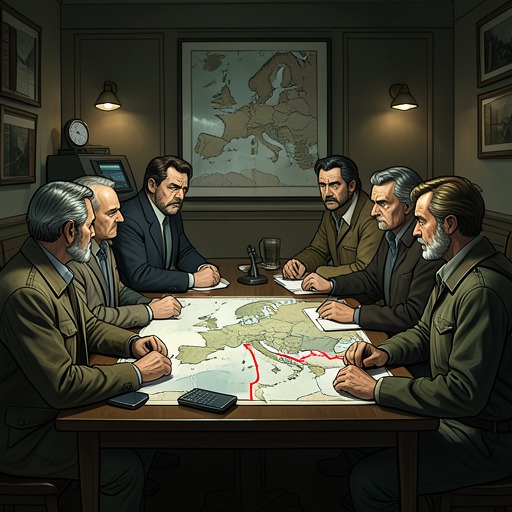
The Glass RoomThe First Czechoslovak Republic is the novel’s lost political possibility: an effort to imagine a Czechoslovak identity beyond German and Slav divisions, and the setting for the modernist confidence embodied by the Landauer House. Its promise is measured not only by Viktor’s hopes for innovation and progress but also by the later persecution that exposes how precarious such a future was. Across changing political orders, the house becomes a material record of those ambitions, their destruction, and their afterlives.
A Chosen Political Identity
For Viktor, the new republic offers more than a change of government. He wants to speak Czech as well as German, reads Lidové Noviny, and speaks of innovation and progress. He rejects being pinned down by race or creed, insisting that Czechoslovaks can choose their history and make a new world. The house he hopes to build is bound to this vision: earlier architectural proposals, with their gables, towers, ornate windows, and mullioned glass, do not fit his sense of a future still to be made.
The novel also frames the republic through the fate of Vítězslava Kaprálová, a real composer whose brief life appears emblematic of the First Republic’s brilliance and doom. The author’s note distinguishes her historical presence from the invented central characters: the Landauers and their story are fictional, while the house and city have been disguised under new names. This distinction makes the republic’s historical context explicit without presenting the novel’s family history as fact.
The House as a Modernist Promise
The Landauer House gives Viktor’s political ideal a built form. After a chance meeting in Venice, the couple considers Rainer von Abt, an architect whose ideals seem oriented toward the future; Viktor notes his claimed study under Adolf Loos. The house’s construction proceeds alongside the growth of the family: the baby’s milestones arrive rapidly, while steel beams, concrete, and enclosed space mark the slower progress of the building. Delays in materials and labour stretch through summer and autumn before the shell is completed in winter.
At first, the finished structure seems almost disappointingly plain, like a warehouse perched on the hillside. Inside, bare concrete, white plaster, dusty floors, and single hanging bulbs make it feel unfinished rather than triumphant. Yet its later reputation rests on the architectural qualities that depart from conventional domestic ornament. A postwar account describes a 230-square-metre living room, two glass walls, south-facing light, and chrome pillars, and identifies the building as von Abt’s masterpiece and his last European work before he fled to the United States in 1938. The contrast between the family’s initial apprehension and its later status as an architectural treasure reflects the changing ways the republic’s modernist inheritance is seen and used.
Persecution and the Unmaking of the Promise
As Nazi measures against Jews intensify in Germany, Viktor rejects the comfort of treating them as distant events. He has come to accept his Jewish identity as a fact of inheritance; German law turns that identity into a basis for exclusion. Were the family in Germany, he would have to rearrange the executive posts and board of Landauerovy Závody so that only Aryans held them, find a different doctor because their family doctor is not Jewish, and confront the prohibition on future marriages between Aryans and non-Aryans. Ottilie and Martin would be classified as Mischlinge. These examples sharpen the novel’s contrast between Viktor’s chosen, inclusive Czechoslovak identity and a racial order that assigns people fixed legal categories.
That contrast does not mean the republic’s promise can protect the house or its owners indefinitely. Under occupation, the building is transformed into a biometric research centre. The upstairs rooms become offices, the kitchens a laboratory, and a basement room is prepared for an X-ray machine. The Glass Room is divided by curtains; anthropometric equipment stands before the onyx wall, while a photographic studio occupies the dining area. The Bösendorfer piano remains, incongruously, amid instruments for measuring and classifying bodies. The house’s transparent modernist ideal is thus repurposed by an institution that turns human difference into administrative evidence.
Reuse, Memory, and Historical Afterlife
In a later period, the Landauer House serves as a children’s gymnasium. Tomáš calls it the Glass Room, a name whose Czech word for room can also mean peace, quiet, or tranquillity. For him, the space is not primarily a monument to its past but a refuge of light and stillness: he watches Zdenka’s dance classes there, finding relief from his work with children disabled by disease. The building’s everyday use gives it a life distinct from both private home and state institution.
A public account of the house makes the conflict over that use explicit. A correspondent acknowledges the importance of treating sick children in a good environment, but questions whether an architectural treasure should serve as a gymnasium. The house is described as a modernist masterpiece in the Blackfield district, overlooking Lužánky Park and the city centre. The debate turns the building into a point of contention between heritage as a preserved object and architecture as a space serving present needs.
After the fall of the Iron Curtain, restoration attempts to return the building to legibility as a monument. Repairs are poor, some original furniture is retrieved from the Moravian Museum, and the bathroom fittings are updated badly; but plate glass replaces the removed window panes, restoring the Glass Room’s lucid appearance. Visitors arrive from fraternal Soviet states and, later, from abroad. Marie Delmas comes from Paris after recognizing in a book on modern architecture a photograph of a memory. The house therefore outlasts the republic that gave its modernist promise political meaning, holding together successive experiences of home, coercion, treatment, preservation, and remembered loss.